Showing posts with label assassinations. Show all posts

Monday, August 5, 2013

Oatmeal, you get me

Dear Matthew Inman,

I have long been an avid reader of your snarky, George Grosz-esque* comics. As a guinea pig-owning vegetarian, I can't really identify with your sage observations on dogs and bacon, but this, this really spoke to me. I don't lift to get pretty**; I lift to be able to chow down on large amounts of fresh-baked bread with aioli and avocado and oil-doused eggplant.


Extremely hot weather is actually a detriment to bread-baking, especially for those of us without thermostats. Bread rises and proofs very quickly in a humid apartment, and running the oven at 475 for 40 minutes requires ozone-slaying doses of AC. Even Peter Reinhart's advice couldn't keep me from over-proofing this one. Andy chowed down on a third of the loaf in one sitting anyway.

No need for a recipe, other than to tell you to use lots of paprika
and put lime juice and black garlic in the aioli!

Oh, and macarons. I will eat all my protein calories from macarons, and let me tell you, at what I estimate to be just under 2 g protein per, that's a lot of cookies! I made a big batch for the end of my EM sub-I. They're not as showy as my first EM rotation's Ativan cupcakes, but a. I used clinical equipment to make them again and b. they let me do this:

Komm, süßer Tod, Part VIII: Abram Aronovich Slutsky

Most readers of this blog never had the privilege of experiencing the USSR firsthand, but Komrad Slutsky certainly did. After a humble birth to a Jewish family in the Parafievka (which I believe is in modern-day Ukraine) and taking part in the bitter fighting of World War I, Slutsky joined the Bolshevik party. The Bolsheviks' October Revolution was, of course, a great success, and Alexander Kerensky's Russia gave way to the (theoretical) rule of the people. Slutsky focused his efforts on securing Soviet authority in central Asia and quickly had a meteoric rise to head of the foreign department of the OGPU. Apparently, this was aided by several shady economic dealings directed against the poor, vulnerable Swedes. From there, it was a short leap to leadership of the whole kit and kaboodle!


Slutsky's tenure in the OGPU was illustrious. He managed to infiltrate Britain with the Cambridge Five and extort false confessions to Stalin's content. Unfortunately for him, the purges spared not even the highest-ranked. One day, Mikhail Frinovsky, deputy head of the secret police (by that point the NKVD... I know, it's complicated), invited Slutsky into his office for some nice, strong Russian tea. One thing lead to another, and soon Frinkovsky's own deputy was summoned... only to find Slutsky dead in his chair. Frinovsky claimed Slutsky died of a heart attack, and indeed Slutsky was known to have had heart trouble for a number of years. He was interred, and everything proceeded smoothly (if you count engineering mass assassinations and the starvation of millions smooth).


But mysteriously, two months after his death of very natural causes, the Party expelled Slutsky from its ranks as an "enemy of the people." Sure enough, just before Frinkovsky's own execution, he admitted that the chief of the NKVD himself had ordered Slutsky sedated with chloroform and injected with cyanide. The chief, Nikolai Ezhov, confirmed this upon his own execution.


The connection: macarons are made from almond flour --> bitter almonds --> cyanide. Almonds are also cool because almond trees are susceptible to aflatoxin-producing fungi. Aflatoxin can either cause acute hepatic necrosis or, on a long-term basis, liver cancer. Neato!

Since this post is already quite lengthy, I might as well extend it more and give you my spiel on macarons. They're light, slightly chewy almond-flour cookies filled with, well, anything! These are plain almond macarons with chocolate-salted caramel ganache. The filling was a little heavy for me, actually, since the cookies are so light.

Macarons require a lot of technique to get right... but the techniques required aren't actually that difficult, manually speaking. You just can't skimp on any of the steps. I'll provide a recipe for the cookies, but first, here are some helpful tips:

1. A scale is pretty much essential. I'll explain why throughout this list.
2. For the cookie batter, use powdered sugar and VERY finely ground almonds. Sift the ground almonds before weighing, especially if you grind your own! Mix the weighed/sifted portion with powdered sugar, and sift in small portions into the beaten egg whites. Here's one place a scale is essential, since all that sifting will give you variable volumes of almonds and sugar (if you're just going by cup measures).
3. Age your egg whites. This just means letting them sit, covered, at room temperature for 6-8 hours or overnight (it gets rid of some of the moisture). Weigh them both before and after aging! Most recipes call for somewhere between 90 and 110 grams of egg white, which may be pre- or post-aging. Pay attention to which it is!
4. Use a gel or powdered food coloring only (I used a few drops of leaf-green Americolor). Water-based dyes will make your batter too sticky, and the cookies will sink.
5. In my experience, letting the piped macarons sit before baking isn't necessary. Smacking the baking sheet firmly on the table is. That way, you get those pretty macaron feet!
6. Finally, DO NOT under any circumstances open the oven after putting the macarons in until you're confident they're at least 90 percent cooked. Opening the oven will crack all your cookies, guaranteed.

The Recipe
100 g egg whites, post-aging weight
1/4 tsp cream of tartar
pinch salt
50 g granulated sugar
100 g almond flour (post-sifting weight)
200 g confectioner's sugar
Optional: 1/4 tsp extract of some sort
Optional: 1/4 tsp gel (or equivalent powdered) food coloring

In a food processor, clean spice grinder, or clean coffee grinder, combine the almond flour and confectioner's sugar. Grind together for about 2 minutes or until very fine. Set aside.

Beat the egg whites with the salt and cream of tartar until foamy. Slowly add the granulated sugar while beating until the whites are stiff; add in the food coloring and extracts just at the end, if using. At this point, begin to preheat your oven to 300 F.

Sift in about half the almond/sugar mixture. With a spatula, swiftly swirl the mixture into the egg whites only about five times. Sift in the rest of the almond/sugar mixture, and GENTLY fold everything together until the batter is homogeneous. DO NOT overmix this. The batter should fall in ribbons that meld together in about 30 seconds.

Line baking sheets with parchment paper. With a piping bag fitted with a round tip (or a 100-cc syringe with the tip cut off), pipe even 1-inch circles about 2 inches apart. They need plenty of space for air circulation! Rap the baking sheet very firmly against the table 5-7 times to get out the air bubbles (if you see them rising, help them along by popping them with a needle or toothpick). Resting the batter isn't necessary, but go for it if you really want.

Bake for 10-12 minutes. DO NOT open the oven until at least 10 minutes have elapsed. Cool on the parchment paper, then gently use a thin metal spatula to lift them off. Fill as desired.

*get it? get it?
**Okay, so this part rings true as well. I'm not an inbred baked potato, but I am a ravening thigh monster.

Sunday, February 24, 2013

Sugarpie, honeybunch


Good luck getting that song out of your head for the rest of the day. If you don't know it, you're welcome.

No excuses for not posting over the past several days. I've been so busy sleeping 10 hours a night and watching awful amounts of Star Trek and cramming my gullet and reading numerous books. I finally picked up A Better Angel by Chris Adrian, with whom I am now mildly obsessed. He's a physician-scholar-author with a bizarre, sinister style like no other. Read this interview with him, then go out and read A Better Angel or The Children's Hospital while I binge-read the rest of his oeuvre. Next stop is Hans Fallada's Wolf Among Wolves.

Food of interest: a rustic mushroom tart (delicious, probably because of all the butter), many salads (delicious despite exiguous butter) and a bruschetta of fava beans with blood orange vinaigrette (also tasty, but unwieldy to eat).

No recipe needed: puree some freshly cooked favas with lemon juice,
salt, pepper, garlic, and a little cooking liquid. Spread on toast. Top with
slices of blood orange and arugula and dressing made with blood orange.
Actually, make a sandwich with eat, because eating this was impossible.

Mmm, cheese and butter. Also mushrooms.
And then there was licorice. Did you know that licorice, if made with all-natural flavoring, can cause hypokalemia and metabolic alkalosis? This is now pertinent to my life because I have eaten so much of this. In honor of my likely death by arrhythmia, I give you something I haven't done in a long time:

Komm, süßer Tod, Part VII: Philip II of Macedon

Licorice root has a number of medicinal qualities, actually. It contains glycyrrhizin and phytoestrogens, and has a number of physiological effects both proven and homeopathically touted. In fact, Alexander the Great may have given it to his troops to sate their thirst during long marches. How did Alexander the Great come to power, you ask? I'll tell you!


It all started with a somatophylax named Pausanias, who was at first content to watch over Alexander's father Philip II as he captured his way around the Mediterranean. Unfortunately, in 336 BCE, something went wrong. Accounts vary; my personal favorite is that Philip II cast aside Pausanias as his lover in favor of a younger, handsomer man named Pausanias. Whatever the cause, Philip was headed into the theater--what is it with theaters and murders of public figures?--when Pausanias pounced and stabbed him in the chest. The assassin immediately turned and ran; he theoretically could have made it to his horse and escaped, had this clumsiest of killers not tripped over a root and thus gotten himself speared to death (and crucified post-mortem). Thus did Alexander ascend to power on the back of Philip II's numerous accomplishments.


I thought cutting it into little squares instead of big twists would limit my consumption of it, but this stuff is just way too good. I modified this recipe simply by omitting the food coloring* (thus the chocolatey brown color) and using honey with a little molasses added to it instead of dark corn syrup. Oh, and I gave it a generous sprinkle of sea salt while I was cooling. All in all, 10/10, would make and devour again. Maybe I'll use buckwheat honey and orange extract next time. One other warning: while I suspect my thermometer is improperly calibrated**, boiling the mixture to precisely 265 degrees F gave me a tougher candy than I expected.

*I swear to god no grocery stores in New York carry this stuff. To find the red coloring for the cupcakes and cookies, I went to no fewer than four grocery stores (thanks, Food Emporium), and I distinctly remember noting that they only carried the typical four-color packs and big bottles of red. No black.
**If anyone else has a digital thermometer and would like to help me check on this, let me know!

Saturday, August 20, 2011

Itallian rapscallion

Yesterday was my (ostensible; I'm actually going in tomorrow) last day of work, and as a thank-you to our rather fabulous PI, my med student co-worker and I assembled a package that included florentines. These delicate caramel-and-almond wafers are, as the name suggest, of Florentine origin, which is why, after many weeks, I bring to you:

Komm, süßer Tod, Part VI: Giuliano de Medici
(florentines, sans the oft-used chocolate and candied citrus peel accoutrements*)


You'd think having a brother nifty enough to get the nickname "the Magnificent" would send Giuliano de Medici into a tailspin of mediocrity. But no, he had to go and co-rule Florence in the late fifteenth century with said brother. Unfortunately, members of the Pazzi and Salviati families butted heads with the Medici rulers of Florence over that most Italian Renaissance of issues: capitalism.


The Pazzi, a banking family had helped the very anti-Medici Pope Sixtus IV purchase some land that Lorenzo and Giuliano had their eye on, thus gaining the financial favors of the pope. Francesco Salviati, having helped with this whole pull-the-wool-dyeing-business-over-Medici-eyes scheme, also got himself named archbishop of Pisa for his efforts. To make a long and complicated story short and oversimplified, after suffering Lorenzo's disapproval one too many times, the Pazzi and Salviati decided to engineer what may be one of the ballsiest assassinations in all of history: have the Medici brothers stabbed to death in front of thousands of people during High Mass at the Duomo, the great cathedral of Florence.


Poor Giuliano bled out on the floor of the church while everyone watched (or fled in fear, more likely), but Lorenzo escaped and actually went on to attempt to defuse the situation, trying to save the lives of Pazzi and Salviati family members and allies. Unfortunately, Salviati was hanged to death at the Palazzo Vecchio, Pazzi family members were murdered by an angry mob, and Pazzi and Salviati family members were in general assaulted and defaced whether or not they had anything to do with the conspiracy... and, as you may have been able to guess, "or not" was the norm. As a last resort, Lorenzo turned himself over to the Neopolitan king Don Ferrante, prostrating himself in captivity for a few months until the king was convinced to help him calm Sixtus down. Lorenzo went on to die quietly in 1492, conveniently avoiding the climax of the whole Savonarola blowup that started during his reign. And even though Giuliano lost his life, his bastard son went on to become a pope. Ah, Italy!


Now, to move to the Iberian peninsula:


This is what happens when you make a sauce of nutmeg, black pepper, and the most delicious cheese ever to be wrapped in sycamore leaves, queso azul de Valdeon...


...add liberal amounts of fresh red grapes, sliced roasted garlic, and flat-leaf parsley...


...and toss a pound of pasta with the whole shebang, then top it with crunchy walnuts and a few more sprigs of parsley for good measure.


This is delicious and delightfully simple. If you can get ahold of the aforementioned cheese, or any other particularly earthy and pungent blue, make this.

*Recipe adapted from Good Housekeeping: Baking and One Perfect Bite. I actually made two batches of this because the first refused to peel off the parchment paper, no matter what I tried. The next batch I baked on lightly greased cookie sheets, which worked like a charm. And those first cookies? Andy ate them, paper and all. The results were surprisingly indigestion-free.

Saturday, May 21, 2011

Prison food

Komm, süßer Tod, Part V: King Erik XIV of Sweden
(yellow split pea soup)

Erik, son of Gustav Vasa, was king of Sweden during the Livonian War and a lot of other hijinks of the type we don't typically associate with Scandinavia today, but let me tell you, it was a bloody, bloody place. For instance: Erik received a good old Calvinist education and was quite an intelligent man. Until, that is, he started going a little nuts. It might have been schizophrenia, it might have been the constant pressure of familial-political disputes, or it might have been gradual arsenic poisoning. After Erik murdered several members of the Sture family upon accusing them of treason and imprisoned his brother John III, people had had enough. A group of nobles sympathetic to his brother dethroned him and imprisoned him in the castle of Orbyhus, where, not long after, he was murdered by eating a bowl of pea soup that had been laced with arsenic.


This soup isn't poisonous. It's darn tasty, though, especially with the enormous amounts of broccoli I continue to enjoy... a meal to revolt any three-year-old!


Not-so-deadly split pea soup
8 oz yellow split peas
1 small onion
2 cloves garlic
1 strip soy, turkey, or real bacon
salt, pepper, and turmeric to taste

Sunday, April 24, 2011

Bread is risen

Okay, so I'm not making hot cross buns until after our exam the day after Easter, but I'm going to preemptively post about them, because:

Komm, süßer Tod, Part IV: Jesus
(hot cross buns, which are spiced and raisin-laden buns with a cross of icing on top)


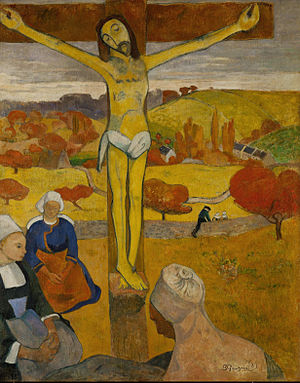
We all know about Jesus. Pretty nice guy, by all accounts, despite incidents like that one parable about the fig tree that continually weirds me out (poor fig tree!). Whether you think he's the son of God or just a nice Jewish boy who got all mixed up in some stuff or a truly crazy Jewish boy whose little cult got way out of control, it seems that around 33 CE, things went all pear-shaped for poor Jesus. Again, everyone knows the story, so I'll just point out that no matter what you think about Jesus, you have to agree that some great art came out of it, like this, and this, and even this.

And now for current content: While lounging on my bed studying* yesterday, I dropped my pen in the crevice between the bed and the wall. To retrieve it, I pulled my bed away from the wall for the first time in months and months and months... and squawked in horror. There were Monty Python-caliber dust bunnies back there. This led me on a frantic sweeping binge that didn't quite get all the dust out of my room, but certainly made great progress to be built on after the exam tomorrow.

As long as spring cleaning was going on, it was natural to eat a primaveran pasta dish: creamy orzo with dill, parsley, peas and shaved asparagus. I adapted it from here for those of us without unlimited fresh herb budgets, which just means that I used dried dill. Other than that, A+.


*I know, I know, you're not supposed to study in your bed. So sue me.

Thursday, March 24, 2011

Vive la revolution!

Komm, süßer Tod, Part III: Jean-Paul Marat
(biscuits au gorgonzola et sauge avec compote de poires)


Once upon a time, there was a French self-made (and, less an honorary degree, self-declared) intellectual and doctor named Jean-Paul Marat. When 1788 rolled around, he ditched the scientific life in favor of incendiary writings on behalf of the Third Estate. To make a long story short, he spent time publishing his journal L'Ami du peuple and went in and out of hiding until 1792, when he got himself elected to the National Convention and turned his attention to hating on a particular legislative faction: the Girondins.


Now, the poor chap had long suffered from a skin disease that has been alternately described as scrofula and chronic dermatitis herpetiformis, aggravated by the time he spent hiding in sewers from his guillotine-happy enemies; as a result, he spent large amounts of time soaking in a bath to alleviate the itching and pain. I'm guessing his friends didn't mind that he was hiding his scaly, scabby self away in a bathroom, too.


Marat carries on, writing political screeds and attempting machinations while sequestered in the tub. And then one day, a young Girondiste named Charlotte Corday showed up at his house and demanded to see him, claiming that she could give him information on a group of Girodins in Normandy. The bescabbed Marat welcomed the befrocked murderess-to-be into his bathroom, where he scribbled notes from their conversation--and no, I'm not sure why she had a fifteen-minute chat before carrying on with her goal for the day. Anyhow, when they were done conversing, Mlle Corday pulled out a kitchen knife she had secreted in her bodice and stabbed Marat in the chest. He promptly exsanguinated.


She got guillotined and he got lauded as a martyr for the cause, so I'm not sure exactly what was accomplished other than the creation of a sticky, bloody mess in that well-used bathroom and the creation of a titillating event depicted to great success by many a painter:

Jacques-Louis David

Edvard Munch
Pablo Picasso
A note on the actual cooking: I played with a recipe I found online to make what I intended to be elegant, Frenchified cookies. Unfortunately, I did not roll them nearly thin enough, and they ended up being quite hefty. And delicious.

Biscuits au gorgonzola et sauge avec compote de poires
Cookies
180 g flour
90 g gorgonzola
60 g butter
1 egg
2 to 3 tablespoons honey
sage and pepper to taste

Cream the butter with the gorgonzola. Add the egg and honey and mix just until blended and smooth (there may still be some small chunks of cheese). Work in the flour, sage, and pepper; if it seems too dry or not cheesy enough, add a little more gorgonzola. Roll out the dough to an eighth of an inch and use cookie cutters or the rim of a glass to cut out rounds. If you want to make sandwich cookies with little windows, use a smaller cookie cutter to cut a round out of half the larger rounds. Brush half the cookies (the "top half" ones) with a little watered-down honey, and bake on parchment paper in a 350-degree oven for 10 to 15 minutes or until lightly browned. Immediately remove from the baking sheet and cool on a wire rack.

Compote
300 g peeled pear, cut into chunks
1 shallot
butter
brown sugar
salt, nutmeg, and sage to taste

Toss the pear chunks with butter and brown sugar and roast in a 450-degree oven until golden brown. Meanwhile, caramelize the shallot in more butter. When the pears are done, add them and the spices to the shallot and cook over medium-low heat until the pears are mashable, at which point... mash them or immersion-blend them. Taste and adjust spice levels, then cook a little further until the compote is thick enough to spread on the cookies; keep in mind that it will thicken somewhat as it cools. Let it cool somewhat, then sandwich the cookies together with a layer of compote in the middle.

Monday, March 21, 2011

Baby's in Black

Komm, süßer Tod, Part II: John Lennon
(Spotted dick* with currants, grated ginger, and lemon and orange zest, and crème anglaise on the side)

I don't have to explain John Lennon to you. I probably don't have to explain how he died, but here goes: John Lennon was one quarter of the uncontested Best Band Ever. The Beatles broke up after a series of hissy fits, and Lennon ended up making less awesome music with the help of his screechy wife, Yoko Ono.


And then one day, an insane man named Mark Chapman shot him with four hollow-point bullets. The public response was, naturally, effusive. A few fans even reportedly committed suicide over Lennon's death.


*First: One usually makes spotted dick with beef suet, but I used grated frozen butter. Secondly: Bet you thought I'd make a strawberry dessert, didn't you, for "Strawberry Fields"? We must remember, however, that before he was John Lennon, More Popular than Jesus, he was John Lennon, Liverpudlian boy growing up with his working-class aunt and uncle. A traditional British steamed pudding seems apropos. Also, there's a personal anecdote in this one: My father and brother, when my family was visiting England about twelve years ago, were offered spotted dick by a waitress as the day's lunch dessert special. To her confusion, they promptly began rolling on the floor with laughter. It's become a small family legend.

Assassins' creed

I have ideas sometimes, which is dangerous, not because they're either brilliant or dangerous in the sense of oh-hey-a-novel-explosive-device, but because they tend to be dangerously cheesy and/or pun-filled. So naturally I'm going to act on the one I had a few days ago. My inner dialogue went kind of like this.

Me: Hmm, Andy wants you to make Milano cookies.
Me: Great! I wonder if they're actually associated with Milan.
Me: Wikipedia says no. Wouldn't it be cool if they were invented at the behest of the Milan royalty or something?
Me: Totally... hey, let's pretend they were invented by the Sforzas* in order to commemorate some birth or assassination or something.
Me: I have an even better idea! Let's make a series of desserts commemorating famous assassinations.

And so it goes, ladies and germs, that I bring you the first installment of my assassination dessert series:

La Sforza del destino
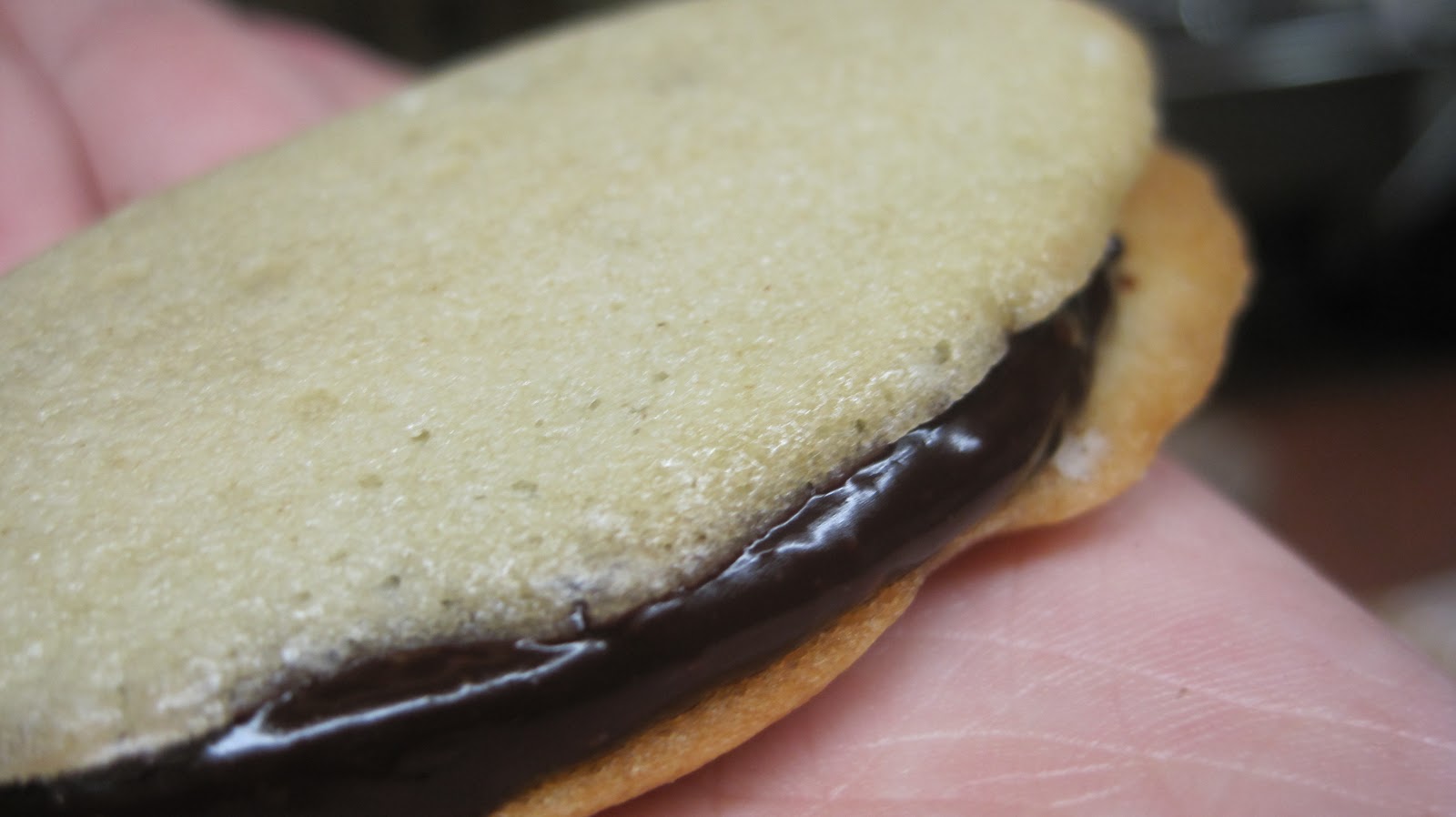
(Milanos, with almond extract-flavored cookies and orange chocolate ganache)

Once upon a time, there was a duke of Milan named Galeazzo Maria Sforza.


The Sforza did some good for the city, and Galeazzo was himself a great patron of music, but he was in all other ways kind of evil.


So three angry and probably more righteous officials, led by a guy named Giovanni Lampugnani, viciously stabbed him to death.


Lampugnani was immediately captured by a mob and gruesomely killed and put on even more gruesome display, a fate that later befell his compatriots as well.


And so ends the reign of the naughtiest of Sforzas, as well as the first entry in what I'm going to call my Komm, süßer Tod series.


*Turns out the Sforzas are actually somehow named in the game Assassins' Creed? I swear I didn't know that until I made this post!